COMMUNICATE RESPONSIBLY AND ETHICALLY
media, communication, self-representation,
and representation and advocacy by NGOs


Ethical representation in communication can be challenging, but every risk offers a great opportunity to improve.
Involving the people represented empowers us to portray them effectively, as nobody knows them better!
Understanding our choices' consequences enables us to take full responsibility for the impact of our content.
this part of the page is for you!

Are you a COMMUNICATION PROFESSIONAL like a journalist, agency worker, advertiser, or an NGO STAFF MEMBER representing different groups in your work?
represent
yourself
represent
others
Are you looking to REPRESENT YOURSELF, or challenge, reshape, or contribute to existing narratives?

communication isn’t just about making noise…
It’s about shaping how people see the world.
If we want real social change, repeating the same old tired tropes with louder megaphones won't cut it:
Focus on tone of voice and empowerment.
Know your audience. What are their values, can you give them something to think about? Check the link to know how!
Acknowledge and reflect diversity. What are existing narratives? Which perspectives are (not) represented?
Integrate historical context. Is a narrative really ‘new’, or has it been rebranded? If so, for what purpose?
Highlight societal contributors.
Prioritize data and evidence-based storytelling.
Focus on systemic solutions. Can you see the structural inequalities? Go beyond the personal.
Check your framing. There is always a psychological frame behind the narrative. What is yours? Know more about framing and social change behavior here.


▄▀▄▀▄ page navigation ▄▀▄▀▄



▄▀▄▀▄ ▄▀▄▀▄ ▄▀▄▀▄ ▄▀▄▀▄ ▄▀▄▀▄ ▄▀▄▀▄ ▄▀▄▀▄ ▄▀▄▀▄
1. FRAMING FOR RESPECTFUL COMMUNICATION
The basics of narratives and core concepts
FRAMING FOR RESPECTFUL COMMUNICATION

Think of a narrative as an invisible pair of glasses. People don't react to raw facts; they react to the story those facts tell.
The Old Narrative formula: Often relies on fear, victimhood, "us vs. them" dynamics, or helplessness. It leaves the audience feeling overwhelmed or defensive.
The New Narrative approach: Shifts the lens toward dignity, agency, shared values, and actionable solutions. Instead of treating people as passive victims or passive audience members, it invites them to be part of a collective answer.
Key takeaway

A story tells you what happened. A narrative tells you what it means—and what we can do about it.

The IMPORTANCE OF KNOWING THE AUDIENCE
FRAMING FOR RESPECTFUL COMMUNICATION

Shouting the right message to the wrong room gets you nowhere. To move people, you need to understand what makes them tick. Check this audience analysis techniques to better know your target.
The public persona for social impact
Instead of treating "the general public" as a single blob, build specific profiles representing your key target groups (e.g., Skeptic Neighbor, Busy Parent, Disillusioned Youth).
Demographics: Age, occupation, media habits.
Pain Points: What keeps them up at night?
Core Drivers: What makes them feel good about themselves?
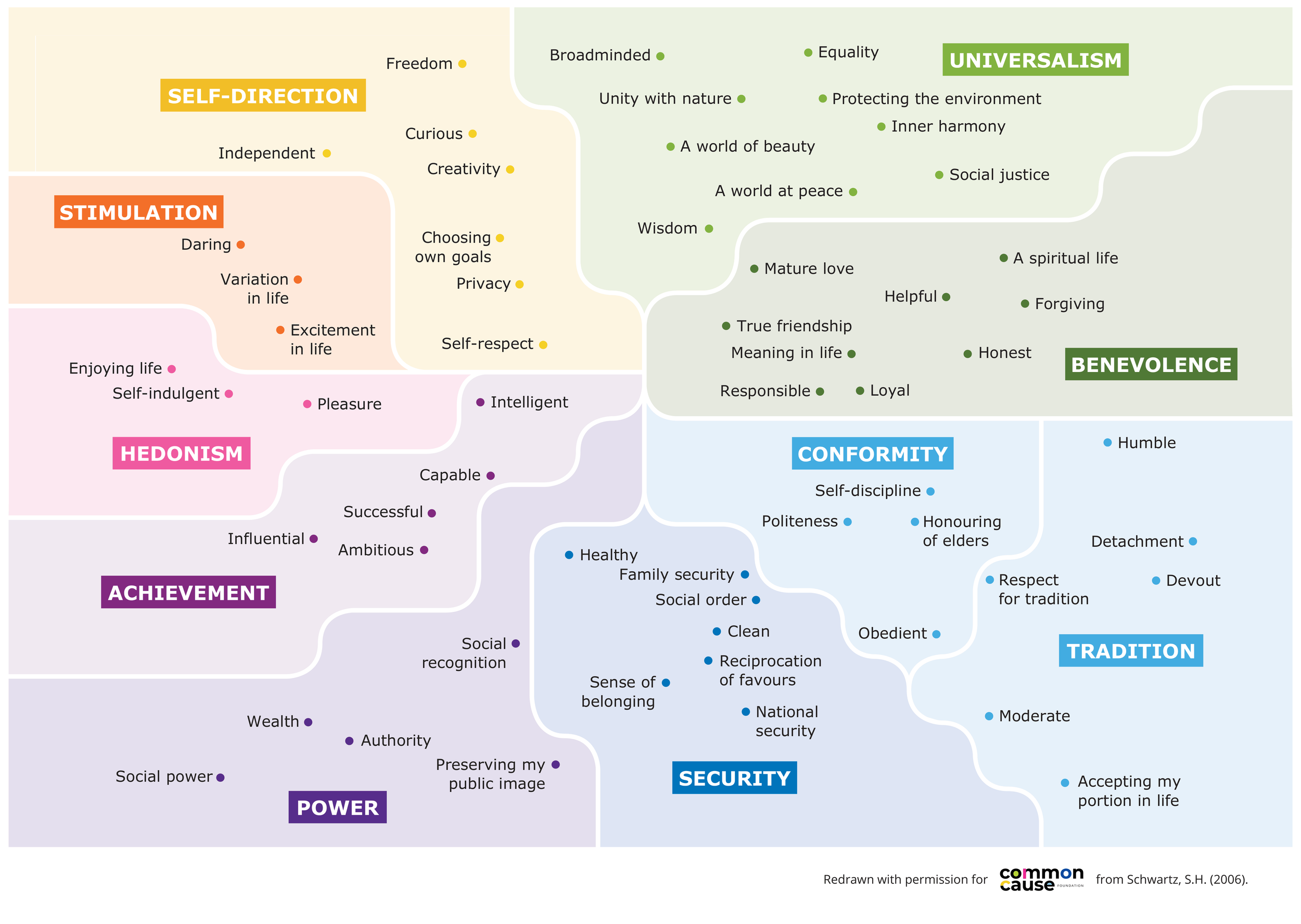
You can also follow Schwartz theory of basic human values:
Shalom Schwartz identified core values that motivate human behavior across cultures. Tapping into these values allows you to frame your message effectively:
Universalism & Benevolence: Focus on equality, justice, and caring for others.
Security & Conformity: Frame social change as a way to preserve harmony, safety, and community stability.
Achievement & Self-Direction: Frame action as an empowering personal growth choice.

Communication psychology: framing & change in social behavior
FRAMING FOR RESPECTFUL COMMUNICATION

Framing: the picture box effect
Every piece of information sits inside a "frame." If you frame immigration as a "flood" or "threat," people instinctively look for dams and barriers. If you frame it as "human mobility" or "community enrichment," people look for opportunities and hospitality.
Social behavior change communication
Information alone rarely changes behavior (otherwise, everyone would sleep 8 hours and drink 2 liters of water daily).
The Trigger: Connect with an existing value (e.g., fairness or safety).
The Emotion: Use positive reinforcement and empathy rather than outrage.
The Action Step: Make the next step clear, simple, and socially rewarding.

have you learnt how to change the frame?
Evaluate yourself playing the New Narratives game. Try to figure out if there is a new narrative or nothing new reflecting about the frames within.
The inclusion in advertising
FRAMING FOR RESPECTFUL COMMUNICATION

In advertising inclusion can be superficial or a genuine commitment.
Reflect on whether you are relying on racialized people merely as decorative background for a product or service.
Nor should they serve as a superficial token of the brand's alleged social responsibility (tokenism).
Diversity should reflect consuming society and represent the complex reality in which the brand exists.
Pursue an inclusive advertising approach that presents diversity in an aspirational light.
Avoid framing social aspiration through structural privilege.
Break away from conventional representation frameworks and respect how people wish to be represented.

co-creation?
Consider integrating the participation of migrants into the creative process to avoid biased or paternalistic perspectives.
Specialist agencies can advise on diversity representation, or you can conduct focus groups with representatives of those social groups. You may discover creative ideas you had never even considered.

▄▀▄▀▄ ▄▀▄▀▄ ▄▀▄▀▄ ▄▀▄▀▄ ▄▀▄▀▄ ▄▀▄▀▄ ▄▀▄▀▄ ▄▀▄▀▄
2. A FORM OF COMMUNICATION
SHOWING REPRESENTATIVELY. What are you showing and why?
FORM OF COMMUNICATION
Images illustrations and tokens. What is the function? Do you have the consent of the people portrayed?
Sources, testimonies and witness. Is there diversity, are voices active or passive, do you label someone solely as a migrant, or do you show the whole person? (e.g. as an experts in other topics or news)
Topics. Do you show migration as a problem, as a natural human phenomenon, as useful… what is your outline?
Advertising. Do you use diversity to show an aspirational society or social criticism? Is the diversity representative of the real make-up of the organisation you advertise?
Format. What is the tone of voice, language, micro and macro structure of the information?

Risks and opportunities: format and more
FORM OF COMMUNICATION

There is not always a right or wrong decision, but our choices when representing people in communication can portray them in a more human and complete way — with dignity and autonomy — or reinforce prejudice, bias, and polarization.
Images, illustrations and tokens
The constant use of anonymous crowds, imagery of misery, systematic suffering, and other negative situations victimize and cause alarm. These types of visual narratives can end up creating distance from the social group represented, producing othering and dehumanization.
Dignified visual treatment
Question whether the image seeks to explain or to shock/impact. A dignified visual treatment positions the protagonists of the story actively and as participants in solutions.
Images with context
Be careful when using generic, decontextualized images (such as reception centers for statistics on migration). If you do not have the right image for that content, use visual metaphors or search archives for images that portray people in an active and hopeful attitude.
Minors and vulnerability
Showing young adults to illustrate issues concerning minors reinforces an inaccurate representation in the collective imagination. You have alternatives if you cannot show the image of a minor: use backlighting, close-up shots, infographics, or illustrations.

Sources and testimonies for communication
FORM OF COMMUNICATION

The sources of a story determine whether people are represented as active citizens or as passive subjects. The choice of who speaks shapes public perception and can challenge structural biases.
Diversify sources to avoid bias
Citing only police, government, or economic sources frames information strictly as a security or resource issue.
Strive to represent a plurality of stories (gender, age, origin,…) and highlight voices that rarely have communicative power or space.
Agency and diversity
Migrants or members of other groups are neighbors participating in community life. If you work in media, include them in any topic beyond migration—such as economy, science, culture, or general current affairs. This restores their status as citizens possessing knowledge and capability.
doing it ethically
FORM OF COMMUNICATION
The framing you apply to your content affects the social perception of the group you are discussing. Consider the main message you want to convey and whether its constituent elements work together coherently to deliver that message.

Migration as a crisis, problem, or drama
Dehumanizes if not accompanied by context and human stories. We must represent the real complexity of this framework to avoid unfair simplifications.
Migration as a usable resource
Risks reducing people to mere labor tools or resources at the service of our needs. What happens when that need vanishes? Human beings possess unconditional human rights.


Migration as a natural fact
Normalizes mobility as a historical process and a matter of shared rights.
Similarities, differences, and belonging
Emphasizing commonalities builds empathy, but omitting differences can make identities invisible. In contrast, a belonging-based approach breaks social barriers and avoids the framework of "assimilation," narrating how to build a new shared understanding.
In addition to the points above, in news reporting, specific elements define the rigor with which information is communicated.
Headline and vocabulary
Avoid stigmatizing or alarmist labels ("wave", "surge", "invasion", "illegal") that dehumanize and reduce people to statistics or threats. Likewise, using individualized language instead of broad generalizations ("migrants", "them") restores agency and dignity to the protagonists.
Craft headlines that highlight causes, contributions, or human experiences and invite understanding.
Content structure
Connect individual cases with broader context and root causes (global, systemic, bureaucratic, etc.) to avoid presenting events as isolated incidents or passing glitches, or blaming individuals for their vulnerable situations. Explore underlying causes and connect them.
For example: find and tell stories where people of different origins (locals and migrants) actively collaborate toward a common goal.

Self-reflection
How can you implement co-creation with the people you write about in your process?
▄▀▄▀▄ ▄▀▄▀▄ ▄▀▄▀▄ ▄▀▄▀▄ ▄▀▄▀▄ ▄▀▄▀▄ ▄▀▄▀▄ ▄▀▄▀▄
3. AN Active approach of ethical representation
Self-identification and respect
This is a fundamental concept. The right of the group to self-determination and self-representation has to be recognized and respected. Instead of TALKING about them, let them TALK about themselves. The representation must be genuine, not just symbolic.

Representation of diversity
The biggest ethical mistake when representing minorities is generaliSation and stereotyping. It is important to portray A group in all its diversity, avoiding an emphasis on characteristics that reinforce societal prejudices.
For example, it is harmful to represent minorities only in the context of poverty or crime.

Inclusion and contextualiSation
Correct representation should not promote alienation, but rather an understanding of the group's place in society.
When decisions are made that directly affect a minority (for example, educational or cultural policies), it is necessary not only to inform, but also to involve representatives of the group and their organiSations in decision MAKING.

integrating co-creation
Consider integrating the participation of migrants into the creative process to avoid biased or paternalistic perspectives.
Specialist agencies can advise on diversity representation, or you can conduct focus groups with representatives of those social groups.
You may discover creative ideas you had never even considered.
▄▀▄▀▄ ▄▀▄▀▄ ▄▀▄▀▄ ▄▀▄▀▄ ▄▀▄▀▄ ▄▀▄▀▄ ▄▀▄▀▄ ▄▀▄▀▄
4. rEPRESENTING YOURSELF / -VES
You are the expert
No one knows your journey better than you, and your voice matters—especially when you are part of a group that is often misrepresented.
If you want to share your story, we encourage you to amplify your voice in the way that feels right for you. There is no single way to represent yourself, and there is no single story that can represent an entire group. Diversity of stories helps us understand the complexity and richness within communities.
We have gathered a few reflection questions to help you make informed decisions, identify the resources available to you, and strengthen the message you want to share.


A
Map your resources
Start by looking at what you already have.
What are your skills and strengths?
Who can support you?
Where and when could you organise?
What other resources are available to you?
Mapping your skills, experiences, contacts and other resources can help you identify your possibilities and choose your strategy.
-
You want to tell stories about migration as a universal human experience. Your group includes people with refugee backgrounds from outside Europe, as well as people who moved between European countries for work or relationships. Someone is a storyteller, someone is good with data, and someone knows the local community centre and can book a space for meetings.

B
Identify allies and networks
Changing the world around us is difficult to do alone. Allies, friends, organisations and wider networks can provide knowledge, skills and support. Making a list of potential allies can help you see what is already available around you and what you might still need.
-
manage a budget;
take and edit photographs;
turn long stories into powerful messages or catchphrases;
advise on digital safety;
facilitate a group;
or simply listen.

c
Identify the risks you can and cannot take
Self-representation can be empowering, but it can also expose us to risks. Before deciding how and where to share your story, think about what you are comfortable with and what you need to protect.
Before deciding on your strategy, you want to understand the possible risks and how to manage them. This game can help you identify potential risks, decide which ones you are willing to take, and adapt your strategy accordingly.
-
You know that mainstream media often talks about trans people rather than with them. You and a group of friends want to challenge this narrative by sharing posts about your everyday lives as trans people.
Is this safe for you? What risks are you willing to take? What choices can you make to reduce the risks you may be exposed to?
The answers depend on the context(s) you are immersed in, your personality, and your overall well-being.
If you live in a place where your physical safety could be at risk simply because you identify as trans, you might want to keep your identity anonymous. If you are going through a period in your life when you feel overwhelmed, you might choose to avoid methods that could add to your stress—for example, using your personal social media account and receiving a large number of comments on your posts.

d
Check for harmful narratives
Think about the stereotypes and prejudices that already exist about your group.
How are they constructed?
Who spreads them, and why?
What impact do they have on your community?
What idea of “normal” lies behind them?
How can you avoid reproducing these narratives in your own self-representation?
Nothing about us without us
This approach is critically important because it safeguards human dignity, prevents the paternalistic erasure of minority voices, and ensures that social interventions are both accurate and effective.

THE POWER OF STORYTELLING
REPRESENTING YOURSELF / -VES
There is something powerful about storytelling, especially when a story is told in the first person. Stories can make complex issues human. They activate our imagination and can create empathy by giving us a glimpse into other people's lives and experiences.
Stories connect us.
There are many ways to tell a story, and only you can decide what feels right for you.



Stories can be personal or collective
You can share your own story, or you can work with others from the same self-identifying group to bring different experiences together and create a collective story or persona.
Stories can be explicit or symbolic
A story can directly describe someone's life and experiences. But it can also use symbols, metaphors or artistic forms to represent a wider experience.
Example: Shadows United, an artistic collective based in Rotterdam, uses the symbol of a shadow to represent the experiences of undocumented people. Through shadow theatre, they explore the feeling of being present in society while remaining unseen or unable to fully participate.
Stories can be concrete or abstract
Storytelling can range from sharing specific events and everyday experiences to highly abstract artistic expression.
In between, there are many possibilities: transforming real experiences through humour, creating a powerful campaign, using photography or theatre, or finding other creative ways to communicate a message.
There is no single right way to tell your story.
BE GENTLE WITH YOURSELF
Not everyone will respond with kindness, and sometimes sharing our stories can make us more vulnerable.
You don't have to be perfect, and you don't have to do everything at once.
Mistakes happen. We can learn from them, adapt and try again. Some days we have the energy to do a lot; on others, we need to pause and recharge.
When representing yourself or your community, remember to take care of your own well-being and boundaries. Your story belongs to you, and you get to decide if, when, where, how and with whom you share it.

▄▀▄▀▄ ▄▀▄▀▄ ▄▀▄▀▄ ▄▀▄▀▄ ▄▀▄▀▄ ▄▀▄▀▄ ▄▀▄▀▄ ▄▀▄▀▄
5. The principles of inclusive representation
ACCURACY AND CONTEXT
Ethical representation demands that portrayals are factually correct and grounded in social reality. That means you don’t make generalisations and include complexity.
Historical and systemic context. Make sure you anchor issues and challenges in systemic and historical inequalities.
Data intergrety. Ensure that all statistics and data used are disaggregated by ethnicity where appropriate, and presented transparently to avoid misinterpretation that could fuel bias.
FOCUS ON AGENCY AND EMPOWERMENT
Emphasise the entrepreneurial spirit, resilience, and contributions of minority group professionals, artists, and activists who are driving positive social and economic transformation.
Harm reduction an dignity
Communication must actively prevent the propagation of harmful stereotypes. For example, biases about criminality or abuse.
AGENCY and VOICE
Focus on Agency, Not Victimhood: While acknowledging historical trauma and current obstacles, the narrative must emphasiSe resilience, leadership, talent, and contribution to the wider society.

▄▀▄▀▄ ▄▀▄▀▄ ▄▀▄▀▄ ▄▀▄▀▄ ▄▀▄▀▄ ▄▀▄▀▄ ▄▀▄▀▄ ▄▀▄▀▄
Games (EN)
For a better online gaming experience, please click to zoom in and enlarge the game.
1. nothing new here?

2. Is this a new narrative?
3. harmful narratives

4. RISK aSSESSMENT

5. The polarization thermometer